Projects

In the park with ‘Écoute pour voir’

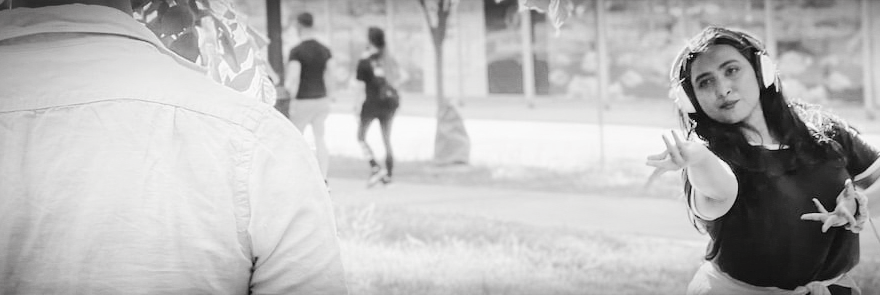
Leading into June, I worked on a dance project called Écoute Pour Voir. Directed by Emmanuel Jouthe, Écoute Pour Voir is a piece that brings together diverse solos in a shared public space. The solos are performed just one spectator at a time, with dancer and viewer sharing a piece of music using headphones. The idea is to create a unique and intimate moment of art.

Choreographing for this project was unfamiliar terrain: when I perform, I don’t see any one person, but now suddenly the crux of the performance would be the idea of connection. The headphones introduced restrictions on movement, but I was also encouraged to think creatively about space, moving beyond proscenium staging. Quite befuddled by these new parameters, I started choreographing slowly in my apartment, wondering what experiences I could share with viewers, what common ground we might have. What emerged from this initial phase of creation was a piece somewhat influenced by the pandemic lockdowns, an expression of isolation, fatigue, weight – some of the things I was dealing with.

But how this piece grew!

On our first day of performances, Emmanuel said that we are always in process, even when we arrive at something we call a “performance.” I performed my solo about 25 times in total, and it always felt like practice, like I was moving towards something new, different or refined. At first I felt awkward and displaced, but with each iteration of the dance, I had a chance to take in my surroundings – the people passing by, peering curiously; the yellow daylight hot on my skin, grass cool under my toes; the trees with drooping leaves and flowers; bumblebees in the shade; and, of course, my viewer. As I danced over and over again, my piece became laden with these surroundings and the emotions they were evoking; I found myself moving freer, responding to and moving with my environment. Though my dance still carried the original sense of isolation and weight from my apartment, each performance brought with it a sense of peace and satisfaction too. Overtime, I felt comfortable, grounded and present. It was really a very nice experience.
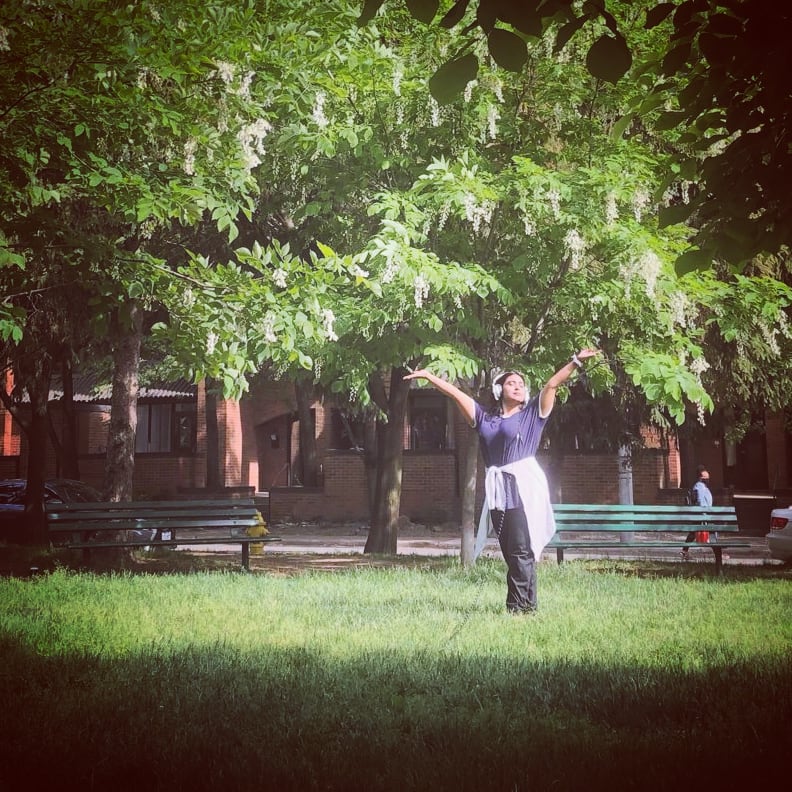
On the last day of performances, I sat in the shade of a pine tree, lazily watching the last few dancers from the sidelines, an outsider once more. I thought a bit about the sense of integration I had experienced, and then at the end, the disintegration, disengaging, disconnecting and going home. I think I have begun to learn something interesting about dance and space – that a dance can be OF and WITH a place (including a part of everything existing in that space), rather than just IN a place. I’m looking forward to exploring this further.

Photo Credits: Isorine Marc and Jasmin Linton, of Jamii Esplanade
Projects, Uncategorized

Action Lab-ing with Peggy Baker Dance Projects

Over the past two weeks, I had the great privilege of working with Peggy Baker, one of Canada’s foremost contemporary dance practitioners, and a cohort of nine emerging artists, as part of an ‘Action Lab’ presented through Peggy Baker Dance Projects. It was a wonderful experience.

The process that Peggy guided us through – based on word and text, conceived of in all aspects (calligraphic, phonetic, semantic/semiotic, etc.), and acted upon in silence under the pressure of time – was quite new to me, and challenging! I experimented with new ways of undertaking choreography, while gently confronting my personal motivations and reservations as a dancer. It was inspiring to work alongside so many talented, creative, and generous artists; our discussions were sites of such interesting ideas that are still steeping in my mind.

You can watch Peggy talking about some of the principles we worked with here. I am sure I will take these ideas forward into my practice.

For the time being, I wanted to share some personal insights that emerged for me through the Action Lab. One day, we took some time to consider our “aspirations for the affect of our work” – ie. what’s important for us in creation, what values do we work from and what qualities do we hope to evoke. It was such a comforting task – a moment to define our artistic selves. I feel that this list, basic as it is and inconclusive as it will surely turn out to be, will help me ground myself as I venture tentatively into contemporary movement creation.

I want my dance work to be…

  • …of nature
  • …of weight/density, of gravity
  • …of meditation
  • …of symmetry
  • …of integrity
  • …of tradition
  • …of rhythm and repetition
  • …of joy
  • …of energy
  • …of respect
  • …of magic
Image
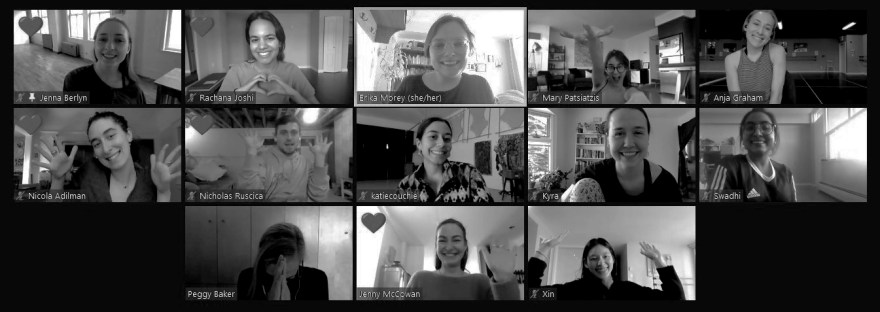
Featured image: A group photo via Zoom of the Action Lab cohort, taken on our last day working together.

Projects

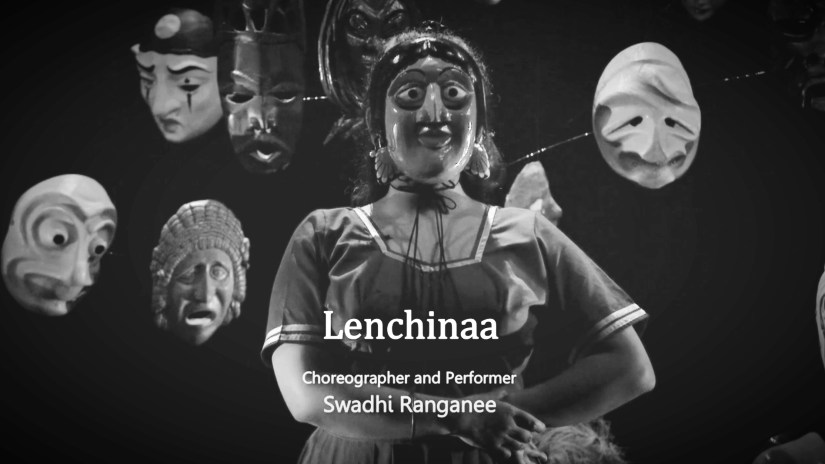
Lenchinaa

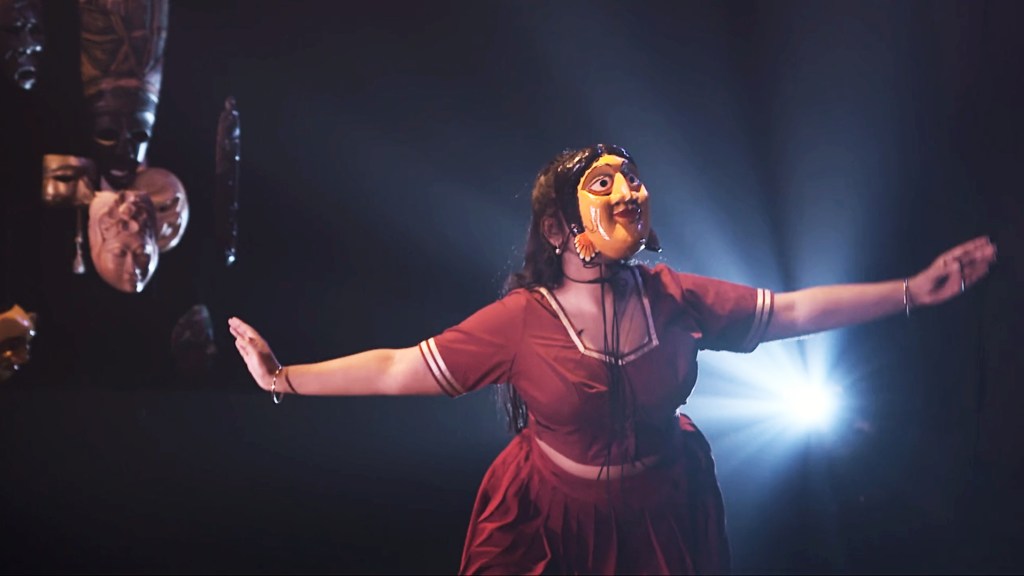
Last month, I presented a Sinhalese dance piece called Lenchinaa through the Citadel as part of their annual Nightshift program, co-presented with Fall for Dance North, one of Toronto’s leading dance festivals. What a privilege it was to share my art and culture in such a way.

Because of Covid-19, the show was livestreamed, under the direction of the amazing, Oscar-nominated Barbara Willis Sweete. I also had the support of Nova Bhattacharya, a creative and truly kind-hearted dancer here in Toronto who acted as my mentor through Nightshift, as well, of course, as my mother and always-teacher Deepa Hettige. It was a remarkable experience and I grew so much through it. I’m proud of the work I created, and hope I can develop it further down the road.

From the Nightshift program:

Swadhi Ranganee’s Lenchinaa explores gendered aesthetics through the medium of Sinhalese folk, traditional, and contemporary dance. Inspired by the mask of Lenchinaa, the flirtatious village beauty of the Kolam tradition, Ranganee’s piece departs from Kolam’s emphasis on comedy while retaining its aim of social commentary, using the mask as a way to focus on the feminized body.

Originally performed by male practitioners, Sinhalese classical dance has transformed through its adaptation out of night-long rituals into the light of the stage and, simultaneously, onto female performers. Dancers often move within gendered parameters; nonetheless, art pushes boundaries, taking the body beyond gender. Ranganee attempts to render such limits and freedoms in her piece, a coming-of-age story in which Lenchinaa finds power, grace, and magic in a journey through movement and dance.

Uncategorized

Dave is the artistic director of a group called “the Parahumans,” and at our first meeting, he tried to explain what this means. Drawing on its etymological roots, he suggested that the parahuman is something “beyond human,” linking this to altered consciousness, somaticisim, spiritualism, and the angelic. Dave’s interest lies mainly in contemporary dance; like many contemporary artists, he spoke of the inhibitions of traditionalism. I’d like to suggest, though, in traditional dance’s defense, that there’s actually quite a strong link between ritual practice and altered or heightened consciousness, artistic somaticism, and indeed, the image and realization of the parahuman.

To speak of what I know: In the Sri Lankan pahatharata shanthikarmaya ritual repertoire, there is a dance called the Waahala dance; during this dance, the dancer enters (what appears to the observer, at least, and may possibly be for the dancer in actuality) a trance-like state. The idea is that he has been possessed by the spirit of the god Waahala himself – he dances vigorously and ceaselessly, beyond the apparent limits of the human body. Paul Wirz describes something similar of the Iramudun-Samayaama dance of traditional thovil (exorcist) repertoire:

Before the dance begins the yakka-actor has his face perfumed with dummala…and as a result he is transformed into a state of rapture which generally…develops into a complete trance…The original tendency seems indeed to have been that an experienced ẹdura continued his dance until he literally broke down, i.e. was in a complete trance. This state is interpreted as a sign that the yakka has now really taken possession of the ẹdura.

Wirz 91-92

While these dance elements are used as a means of realizing, through altered consciousness, a divine parahuman self, Wirz also suggests that this altered consciousness is enabled precisely through the learned nature of traditionally established movements:

…only the older ẹduro know how to reach [this complete trance], for only many years of exercise and training enable them to attain this condition within a more or less reasonable length of time. The whole way of performing such a dance by an experienced ẹdura is intended to induce a trance.

Wirz 92

Any artist who has extensively practiced a technique – which is to say, a series of movements – is familiar with the way it embeds itself in the muscle’s memory – a point at which the conscious mind could fall asleep because the body has developed a mind of its own. It is something meditative. But, unlike the (largely, in my opinion, westernized) understanding of meditation as an emptying of the self, it is rather a deep – and, I emphasize, deeply disciplined – awareness of the physical self, like focusing on breathing until there is nothing else. So many dancers speak about this state; just today, reading about a choreographer featured in this year’s Fall for Dance North festival, I ran into this:

Strange paradox: when I dance, my body takes over…when that happens, I feel my dancing in its truest, purest form. From time to time, I achieve this state of grace…it is to find those moments of grace that I dance.”

Anne Plamondon

I imagine Anne’s “grace” is not unlike the Waahala dancer’s possession. My point is simply that there are ways in which traditional and contemporary art have something integral in common, a similar aim, function, and product: art, which is an instance of para-humanity. At the same time, I level a gentle criticism at the art world’s elevation of contemporary forms of dance as somehow purer or more authentic than traditional, classical, or ritual practices.