Uncategorized

Small reflections on 2020

2020 has been bizarre, uncertain, full of change, and difficult for so many. My dancing feels inconsequential among all this.

Nonetheless, this year has taught me some things about myself and my relationship to movement and the world. My journey through dance has continued and my ideas have evolved somewhat. I think that’s worth noting, at least for myself.

So here are a few small reflections to close out this strange year.

1. Isolation, energy, and further thoughts

I have been surprised to discover that I, an introvert, not only miss social activity, but feel worn down by its lack. Nowadays, I’m most awake when chatting with friends on a video call, or even just sharing an elevator with a neighbour. Of course I’m familiar with the thrill of a live audience – the rush that enlivens the limbs – but I never thought to connect this to the ways energy is produced and sustained in quotidian movement and social performance – the way a face twitches, tenses, lights up – involuntarily energized -, for example, in the presence of another human being. I realize now that we draw energy from one another, not only when performing, but in everyday life. I am so curious about the nature of that energy, and what it might say about how dance relates to other social acts.

2. Dance is the thing that feels like being alive

The global shift to digital modes of performance, practice, and instruction has left me thinking a lot about what counts as dance. Having watched performances online and even choreographed a piece for livestream, I have clarified that, for me, dance is so much more than a visual medium. What feels like dance to me (whether as performer or as spectator) reverberates in the body – the music and energy is immersive – an experience that is a challenge to replicate through image alone. What feels like dance to me is something more immediate.

Of course, this definition is very personal, defined through my lived experiences as an able-bodied woman. Perhaps a definition that might better fit across various experiences is: dance is the thing that makes your body and heart feel charged, buzzing, and alive.

3. Practice makes peace

It’s been interesting to see how people have managed with the built up tensions of Covid-19. Lots of people turned to baking. Others took up gardening. I did a bit of both – and like many other dancers, I found special comfort in fostering a practice of fundamentals – daily stretching, basic technique and choreography classes, running drills of the first 12 steps of Kandyan dance… There’s often so much pressure to progress and produce new things; this year helped me discover the joy and peace of practice for its own sake, something I want to carry forward.

Projects

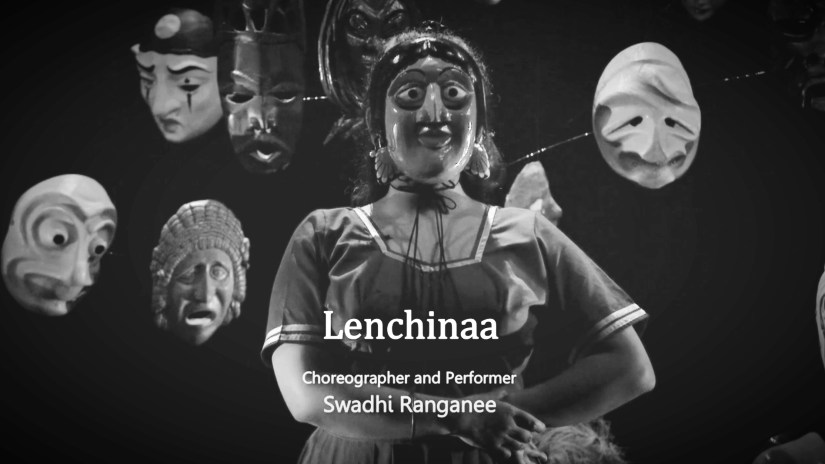
Lenchinaa

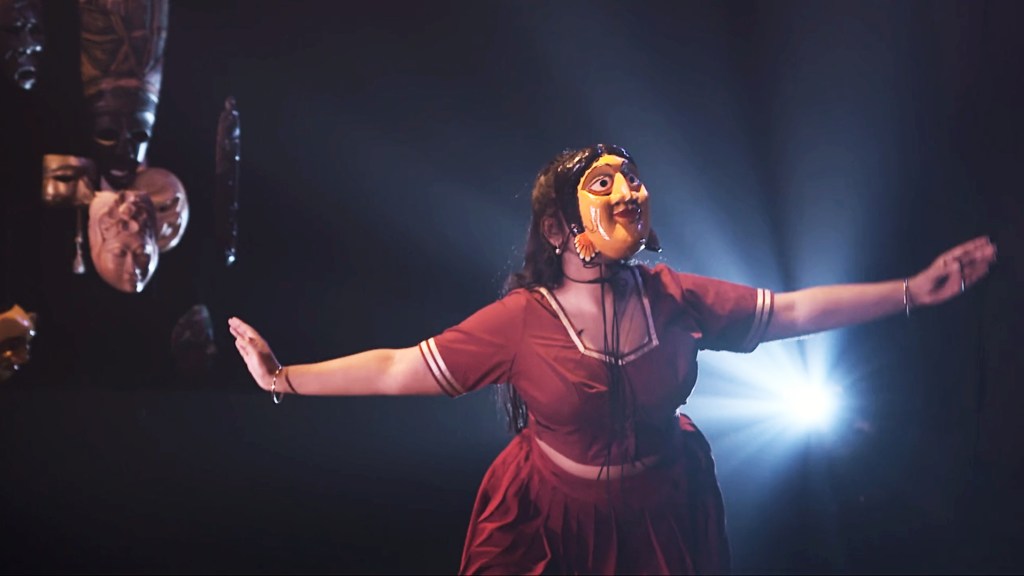
Last month, I presented a Sinhalese dance piece called Lenchinaa through the Citadel as part of their annual Nightshift program, co-presented with Fall for Dance North, one of Toronto’s leading dance festivals. What a privilege it was to share my art and culture in such a way.

Because of Covid-19, the show was livestreamed, under the direction of the amazing, Oscar-nominated Barbara Willis Sweete. I also had the support of Nova Bhattacharya, a creative and truly kind-hearted dancer here in Toronto who acted as my mentor through Nightshift, as well, of course, as my mother and always-teacher Deepa Hettige. It was a remarkable experience and I grew so much through it. I’m proud of the work I created, and hope I can develop it further down the road.

From the Nightshift program:

Swadhi Ranganee’s Lenchinaa explores gendered aesthetics through the medium of Sinhalese folk, traditional, and contemporary dance. Inspired by the mask of Lenchinaa, the flirtatious village beauty of the Kolam tradition, Ranganee’s piece departs from Kolam’s emphasis on comedy while retaining its aim of social commentary, using the mask as a way to focus on the feminized body.

Originally performed by male practitioners, Sinhalese classical dance has transformed through its adaptation out of night-long rituals into the light of the stage and, simultaneously, onto female performers. Dancers often move within gendered parameters; nonetheless, art pushes boundaries, taking the body beyond gender. Ranganee attempts to render such limits and freedoms in her piece, a coming-of-age story in which Lenchinaa finds power, grace, and magic in a journey through movement and dance.

Uncategorized

Mirror, mirror, on the studio wall

I’ve been taking online classes recently, in a variety of unfamiliar styles, from the comfort of my living room. A friend remarked that he’s surprised at how I manage to learn so well without a mirror – his surprise surprised me. I never used dance mirrors growing up: all my formative training took place at home, in community spaces, and on the stage; I didn’t step into a “fully equipped studio” until I was 19. This isn’t special or uncommon either. Plenty of dancers primarily learn and practice outside of studios, proving the case that a mirror is not necessary for dance.

So I’ve been thinking about this mode of learning, as well as the general history of Sri Lankan dance education, against the ubiquity of mirrors in dance studios. Mirrors are so central to “professional” training now, particularly in the European classical tradition, but increasingly in other contexts as well. According to Sally Raddell, since their emergence in ballet training of the 18th century, mirrors in dance studios have become the “primary mode of information gathering.”

In contrast, traditional Sinhalese dance training favoured, I would argue, non-visual modes of self-awareness. Our traditions speak of daeka purudda, aaha purudda, kara purudda (“habits of seeing, hearing, doing”) – a pedagogy emphasizing practice, muscle memory, and embodiment, rather than visual ideals. Susan Reed, writing on how traditional Sinhalese dance is taught through demonstration, calls this “knowledge transmission based primarily on mimesis” – but the concept of imitation centralizes the idea of the image. To shift that focus, I would add that, given an absence of large mirrors in Sinhalese villages, traditional dance education involved imitation without visual self-verification. Having only the body as its own reference, dancers would have to rely on internalized modes of immediate feedback and self-verification to effectively see themselves without actually seeing themselves; they would need to focus on developing an attention to the spatial positioning of moving bodies (developed through kara purudda) in relation to temporal rhythms (developed through aaha purudda).

Kinesthetics calls this kind of non-visual, bodily self-awareness proprioception. Raddell considers this “felt understanding of exactly where one’s body is and what it is doing” a “critical ingredient to being [an]…expressive dancer,” and notes that mirrors may delay its development: “The image students see…in the mirror and the feedback it provides can frequently overpower the kinesthetic feedback students feel in their bodies and must learn to interpret.” She quotes Montero here: “a trained dancer often trusts proprioception more than vision.” I’m reminded that every time I perform, I do so without glasses, frequently in unfamiliar spaces, with the worst eyesight of anyone I personally know. The term proprioception is new to me, but the concept of this “sixth sense” feels true to my experiences.

I’m finding that both the teaching and performance of Sri Lankan dance nowadays have, for myriad reasons, moved towards a greater emphasis on aspects of line, form, precision, as if the ideal of dance is primarily visual. The purpose of this post is not at all to knock mirrors as aids in dance practice, but to promote and explore other traditional modes of learning, understanding, and interpreting movement which do not privilege sight over other senses.

Sources

Raddell, Sally. “Mirrors in the Dance Class: Help or Hindrance?” IADMS.

Reed, Susan. “Women and Kandyan Dance: Negotiating Gender and Tradition in Sri Lanka.”

Uncategorized

Basic Sinhala drumming concepts

A central area of interest for me is the connection between drumming, dance, song, and text. It seems to me these practices share mutual ground in the Sinhalese performance context (with many inter-penetrative elements) despite their gradual distillation and crystallization into distinct disciplines through the influence of a particular structure of education (compare what Bob Simpson calls the “total context” of learning within the old ritual system, to the modern education system, for a sense of this).

I’m working towards a longer article on this topic. In the meantime, I thought I would share a handful of key theoretical terms I have learned of, related to Sinhalese and South Asian drumming, some of which exemplify the porous nature of Sinhalese drumming in relation to adjacent disciplines.

akshara – a drum letter or syllable, which can represent both timing and quality within the context of memorized patterns; these can be performed both vocally and percussively. Comparable to North Indian bol and South Indian solkattu. The five basic Sinhalese drum syllables, out of which many others can be derived, are thath, jith (or dith), toṃ, naṃ, and tha.

maatraa – a beat within a rhythmic cycle (taala, see below), with the first beat called the sam.

padaya – A complete line of drumming. The root “pada,” meaning foot, evokes the inter-relationships I’m so interested in. As Jim Sykes insightfully notes, “As a word that refers to poetic feet, ‘pada’ has roots in the Hindu Vedas and early texts for thinking about the relations between music, dance, and theatre.” (Of particular interest, too, are bara (“heavy”) pada, which are elongated but also performed by both drummer and dancer in a more grounded (ie. heavier) fashion, linking the temporal with the physical or affective.)

taala – musical meter, or a regularly recurring pattern of beats and accents. Taala is usually kept in South Asian traditions via a clap and wave system, finger-counting method, or with percussive instruments (eg. taalampota). I like the distinction Sykes makes between rhythm and meter when he defines meter as “abstract, measured pulse points” – ie. a theoretical abstraction that attends to embodied rhythm.

thithkramaya – A theory of Sinhala drumming music by W.B. Makulloluwa (1922-1984) who developed it as a pedagogical tool for implementation within the emergent national school system in Sri Lanka. “Thith” refers to the short stroke produced on the tālampota (the other, long stroke being theyi). Many scholars find this system inadequate, especially when it comes to theorizing low-country traditions.

***

SOURCES

Simpson, Bob. “Possession, Dispossession and the Social Distribution of Knowledge Among Sri Lankan Ritual Specialists.”

Suraweera, Sumuditha. Sri Lankan, Low-Country, Ritual Drumming: The Raigama Tradition.

Sykes, Jim. “South Asian Drumming Beyond Tala.”

Uncategorized

Happy New Year, with thoughts on ritual cleaning

With the flurry of cleaning that traditionally marks the coming of the new year in my household, I began to think about cleaning as a ritual act, evident across so many cultures. Perhaps the most well-known in the western secular world is the tradition of spring cleaning, with possible roots in the Persian new year tradition of kahneh tekani (“shaking the house”); Jewish Passover traditions; Maundy Thursday altar cleanings, foot washings; and so on. The Japanese similarly have a new years’ tradition called o-souji, a weeks-long deep decluttering and dusting.

In the context of Sinhalese performance, cleaning is a highly significant, carefully ritualized component of most ceremonies. Ritual practitioners of the Dewol Madu Shanthikarmaya, for example, will often practice abstinence from meat and alcohol leading up to a ceremony, and wear fresh white cloth. The ritual performance space, the ranga bhoomiya, is not only cleaned but further festooned with fresh flowers, gok-kola (palm leaf) artwork, and lamps; this extensive preparation is a communal activity that often engages an entire village for weeks, in an overspilling of human effort. During the ceremony itself, the ritual space is regularly refreshed with kaha diya (turmeric water) and anguru dummal (charcoal smoke).

In the Sinhalese ritual context (and I suspect this to be true of most religious rituals), the aim of cleaning and decorating is to create beauty as a divine offering or bribe, in order to attract the beneficent gaze of gods. In other words, it is believed that the pleasant appearance, fragrance, aroma, flavour, and sounds of a ritual ceremony attract divine interest, just as they attract the interest of humans.

There is indeed a kind of duality at work in ritual cleaning, then, and in ritual overall, in that it is something done both for the benefit of gods and for the benefit of humans, and these are inextricably entwined. In the ritual context, the cleaning of outer space is a means of purifying the inner space of mind and spirit as well: a kind of ritualized therapy.

The persistence of cleaning rituals, even into these secular times, causes me to consider the therapeutic, mental or emotional effects of cleanliness and order to be of some significance in understanding both human nature and the development of ritual. Plenty of animals, after all, have a natural instinct for cleanliness and order. How many of our rituals, how much of dance and art, have root in our animal instincts?

Uncategorized

Hello!

ගමන් තාලෙ
/ga mʌn ‘θɑ leɪ/ (ga-muhn THAH-ley)

From the Sinhalese gamana, meaning “journey,” and thaala, meaning rhythm or beat, the gaman thaale is a fundamental element in traditional Sinhalese dance vocabularies. Essentially a stylized stroll around the entirety of the stage, the gaman thaale typically occurs in the middle of a dance sequence, as an interlude. It is a chance for the dancer to gather his or her energy while both gauging and engaging the entire performance space.

I started learning Sinhalese dance when I was a wee thing, and I never thought much of it. I more or less mindlessly got into it the way children do – but as I’ve grown with it and into it, it’s become both a love and a fascination.

So I am starting this blog to serve as something of a gaman thaalayak within my own life of dancing — a moment to saunter through reflections, memories, and ideas, taking stock of the field, gaining ground.

While I expect this blog will help me flesh out my own vague ideas to some extent, I also hope that, as I engage with other writing, research, and media on Sinhalese dance in particular, this site will grow into a compendium of resources on this under-represented dance form. If it doesn’t, at least I’ll have spent more time dwelling on something I love.

That’s the blogging journey I see before me for now. So, away we go!