Projects

In the park with ‘Écoute pour voir’

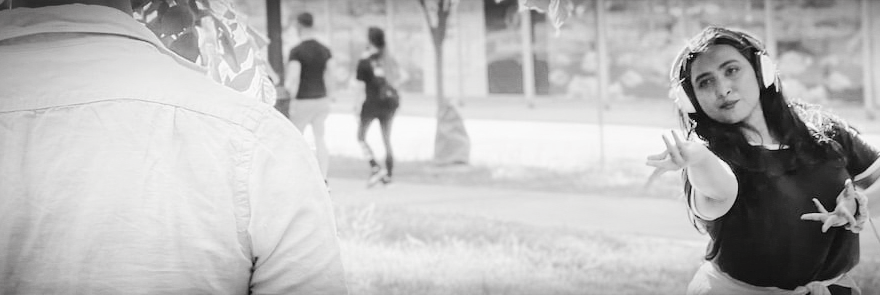
Leading into June, I worked on a dance project called Écoute Pour Voir. Directed by Emmanuel Jouthe, Écoute Pour Voir is a piece that brings together diverse solos in a shared public space. The solos are performed just one spectator at a time, with dancer and viewer sharing a piece of music using headphones. The idea is to create a unique and intimate moment of art.

Choreographing for this project was unfamiliar terrain: when I perform, I don’t see any one person, but now suddenly the crux of the performance would be the idea of connection. The headphones introduced restrictions on movement, but I was also encouraged to think creatively about space, moving beyond proscenium staging. Quite befuddled by these new parameters, I started choreographing slowly in my apartment, wondering what experiences I could share with viewers, what common ground we might have. What emerged from this initial phase of creation was a piece somewhat influenced by the pandemic lockdowns, an expression of isolation, fatigue, weight – some of the things I was dealing with.

But how this piece grew!

On our first day of performances, Emmanuel said that we are always in process, even when we arrive at something we call a “performance.” I performed my solo about 25 times in total, and it always felt like practice, like I was moving towards something new, different or refined. At first I felt awkward and displaced, but with each iteration of the dance, I had a chance to take in my surroundings – the people passing by, peering curiously; the yellow daylight hot on my skin, grass cool under my toes; the trees with drooping leaves and flowers; bumblebees in the shade; and, of course, my viewer. As I danced over and over again, my piece became laden with these surroundings and the emotions they were evoking; I found myself moving freer, responding to and moving with my environment. Though my dance still carried the original sense of isolation and weight from my apartment, each performance brought with it a sense of peace and satisfaction too. Overtime, I felt comfortable, grounded and present. It was really a very nice experience.
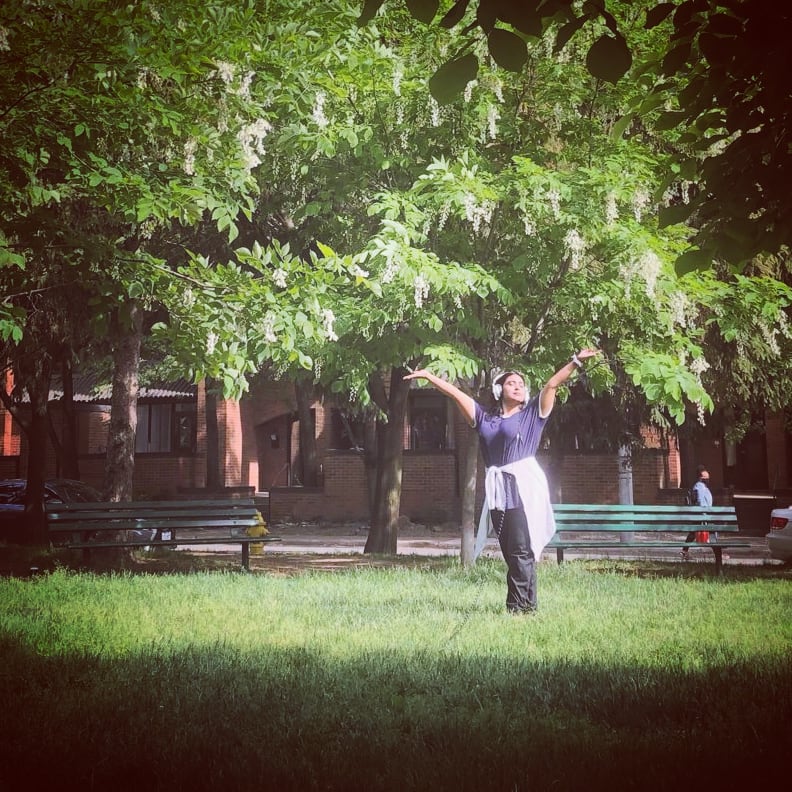
On the last day of performances, I sat in the shade of a pine tree, lazily watching the last few dancers from the sidelines, an outsider once more. I thought a bit about the sense of integration I had experienced, and then at the end, the disintegration, disengaging, disconnecting and going home. I think I have begun to learn something interesting about dance and space – that a dance can be OF and WITH a place (including a part of everything existing in that space), rather than just IN a place. I’m looking forward to exploring this further.

Photo Credits: Isorine Marc and Jasmin Linton, of Jamii Esplanade

Uncategorized

Small reflections on 2020

2020 has been bizarre, uncertain, full of change, and difficult for so many. My dancing feels inconsequential among all this.

Nonetheless, this year has taught me some things about myself and my relationship to movement and the world. My journey through dance has continued and my ideas have evolved somewhat. I think that’s worth noting, at least for myself.

So here are a few small reflections to close out this strange year.

1. Isolation, energy, and further thoughts

I have been surprised to discover that I, an introvert, not only miss social activity, but feel worn down by its lack. Nowadays, I’m most awake when chatting with friends on a video call, or even just sharing an elevator with a neighbour. Of course I’m familiar with the thrill of a live audience – the rush that enlivens the limbs – but I never thought to connect this to the ways energy is produced and sustained in quotidian movement and social performance – the way a face twitches, tenses, lights up – involuntarily energized -, for example, in the presence of another human being. I realize now that we draw energy from one another, not only when performing, but in everyday life. I am so curious about the nature of that energy, and what it might say about how dance relates to other social acts.

2. Dance is the thing that feels like being alive

The global shift to digital modes of performance, practice, and instruction has left me thinking a lot about what counts as dance. Having watched performances online and even choreographed a piece for livestream, I have clarified that, for me, dance is so much more than a visual medium. What feels like dance to me (whether as performer or as spectator) reverberates in the body – the music and energy is immersive – an experience that is a challenge to replicate through image alone. What feels like dance to me is something more immediate.

Of course, this definition is very personal, defined through my lived experiences as an able-bodied woman. Perhaps a definition that might better fit across various experiences is: dance is the thing that makes your body and heart feel charged, buzzing, and alive.

3. Practice makes peace

It’s been interesting to see how people have managed with the built up tensions of Covid-19. Lots of people turned to baking. Others took up gardening. I did a bit of both – and like many other dancers, I found special comfort in fostering a practice of fundamentals – daily stretching, basic technique and choreography classes, running drills of the first 12 steps of Kandyan dance… There’s often so much pressure to progress and produce new things; this year helped me discover the joy and peace of practice for its own sake, something I want to carry forward.

Uncategorized

Hello!

ගමන් තාලෙ
/ga mʌn ‘θɑ leɪ/ (ga-muhn THAH-ley)

From the Sinhalese gamana, meaning “journey,” and thaala, meaning rhythm or beat, the gaman thaale is a fundamental element in traditional Sinhalese dance vocabularies. Essentially a stylized stroll around the entirety of the stage, the gaman thaale typically occurs in the middle of a dance sequence, as an interlude. It is a chance for the dancer to gather his or her energy while both gauging and engaging the entire performance space.

I started learning Sinhalese dance when I was a wee thing, and I never thought much of it. I more or less mindlessly got into it the way children do – but as I’ve grown with it and into it, it’s become both a love and a fascination.

So I am starting this blog to serve as something of a gaman thaalayak within my own life of dancing — a moment to saunter through reflections, memories, and ideas, taking stock of the field, gaining ground.

While I expect this blog will help me flesh out my own vague ideas to some extent, I also hope that, as I engage with other writing, research, and media on Sinhalese dance in particular, this site will grow into a compendium of resources on this under-represented dance form. If it doesn’t, at least I’ll have spent more time dwelling on something I love.

That’s the blogging journey I see before me for now. So, away we go!