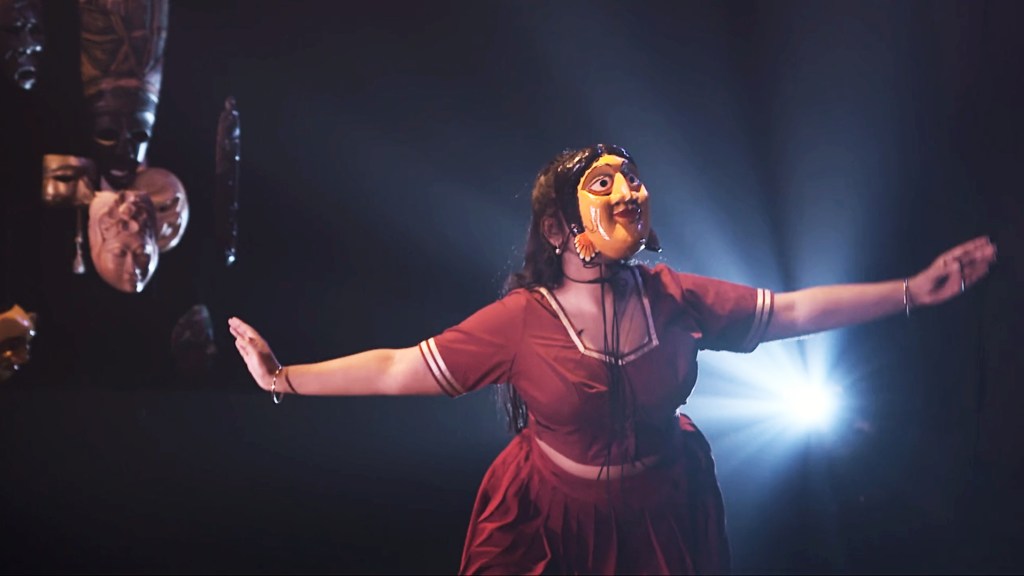
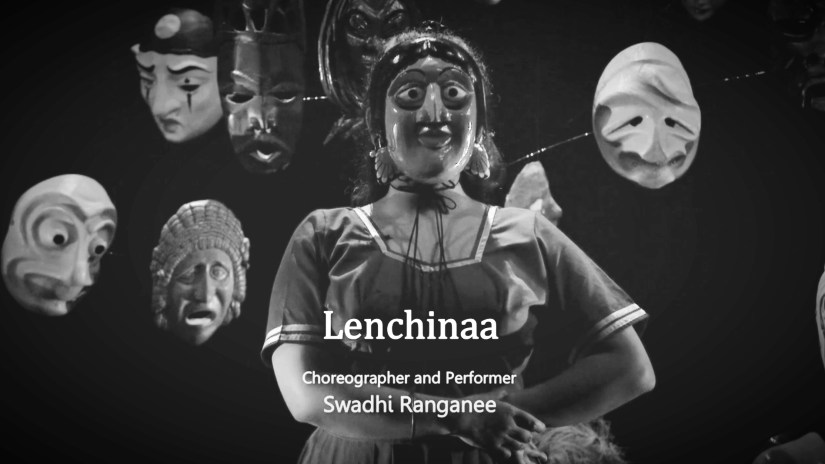
Last month, I presented a Sinhalese dance piece called Lenchinaa through the Citadel as part of their annual Nightshift program, co-presented with Fall for Dance North, one of Toronto’s leading dance festivals. What a privilege it was to share my art and culture in such a way.
Because of Covid-19, the show was livestreamed, under the direction of the amazing, Oscar-nominated Barbara Willis Sweete. I also had the support of Nova Bhattacharya, a creative and truly kind-hearted dancer here in Toronto who acted as my mentor through Nightshift, as well, of course, as my mother and always-teacher Deepa Hettige. It was a remarkable experience and I grew so much through it. I’m proud of the work I created, and hope I can develop it further down the road.
From the Nightshift program:
Swadhi Ranganee’s Lenchinaa explores gendered aesthetics through the medium of Sinhalese folk, traditional, and contemporary dance. Inspired by the mask of Lenchinaa, the flirtatious village beauty of the Kolam tradition, Ranganee’s piece departs from Kolam’s emphasis on comedy while retaining its aim of social commentary, using the mask as a way to focus on the feminized body.
Originally performed by male practitioners, Sinhalese classical dance has transformed through its adaptation out of night-long rituals into the light of the stage and, simultaneously, onto female performers. Dancers often move within gendered parameters; nonetheless, art pushes boundaries, taking the body beyond gender. Ranganee attempts to render such limits and freedoms in her piece, a coming-of-age story in which Lenchinaa finds power, grace, and magic in a journey through movement and dance.
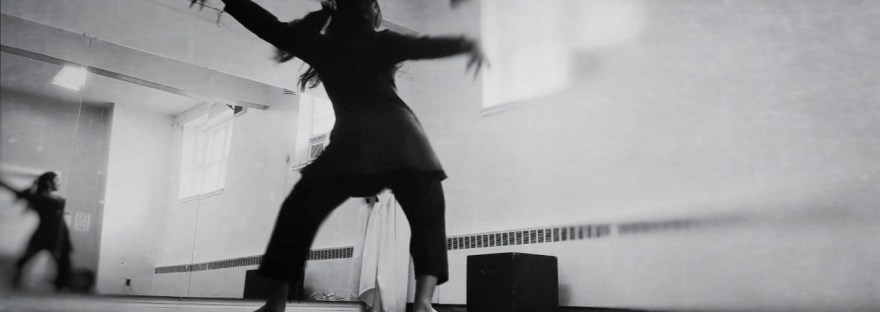
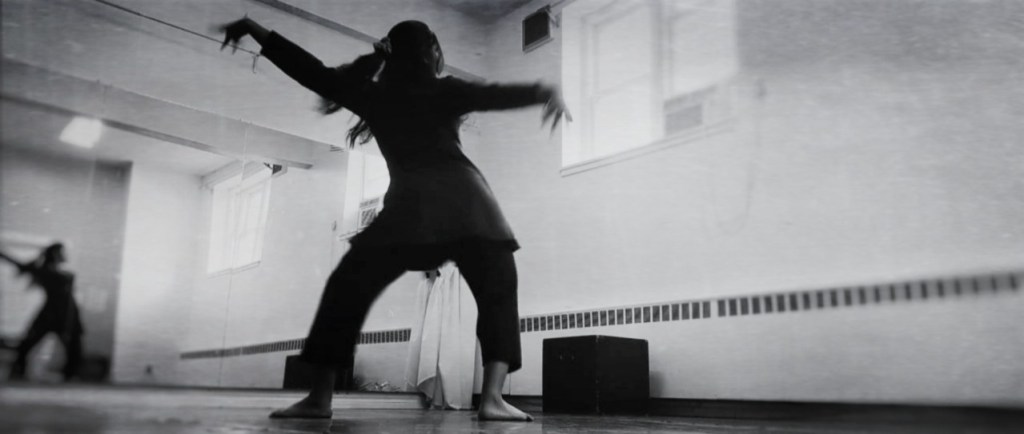
I’ve been taking online classes recently, in a variety of unfamiliar styles, from the comfort of my living room. A friend remarked that he’s surprised at how I manage to learn so well without a mirror – his surprise surprised me. I never used dance mirrors growing up: all my formative training took place at home, in community spaces, and on the stage; I didn’t step into a “fully equipped studio” until I was 19. This isn’t special or uncommon either. Plenty of dancers primarily learn and practice outside of studios, proving the case that a mirror is not necessary for dance.
So I’ve been thinking about this mode of learning, as well as the general history of Sri Lankan dance education, against the ubiquity of mirrors in dance studios. Mirrors are so central to “professional” training now, particularly in the European classical tradition, but increasingly in other contexts as well. According to Sally Raddell, since their emergence in ballet training of the 18th century, mirrors in dance studios have become the “primary mode of information gathering.”
In contrast, traditional Sinhalese dance training favoured, I would argue, non-visual modes of self-awareness. Our traditions speak of daeka purudda, aaha purudda, kara purudda (“habits of seeing, hearing, doing”) – a pedagogy emphasizing practice, muscle memory, and embodiment, rather than visual ideals. Susan Reed, writing on how traditional Sinhalese dance is taught through demonstration, calls this “knowledge transmission based primarily on mimesis” – but the concept of imitation centralizes the idea of the image. To shift that focus, I would add that, given an absence of large mirrors in Sinhalese villages, traditional dance education involved imitation without visual self-verification. Having only the body as its own reference, dancers would have to rely on internalized modes of immediate feedback and self-verification to effectively see themselves without actually seeing themselves; they would need to focus on developing an attention to the spatial positioning of moving bodies (developed through kara purudda) in relation to temporal rhythms (developed through aaha purudda).
Kinesthetics calls this kind of non-visual, bodily self-awareness proprioception. Raddell considers this “felt understanding of exactly where one’s body is and what it is doing” a “critical ingredient to being [an]…expressive dancer,” and notes that mirrors may delay its development: “The image students see…in the mirror and the feedback it provides can frequently overpower the kinesthetic feedback students feel in their bodies and must learn to interpret.” She quotes Montero here: “a trained dancer often trusts proprioception more than vision.” I’m reminded that every time I perform, I do so without glasses, frequently in unfamiliar spaces, with the worst eyesight of anyone I personally know. The term proprioception is new to me, but the concept of this “sixth sense” feels true to my experiences.
I’m finding that both the teaching and performance of Sri Lankan dance nowadays have, for myriad reasons, moved towards a greater emphasis on aspects of line, form, precision, as if the ideal of dance is primarily visual. The purpose of this post is not at all to knock mirrors as aids in dance practice, but to promote and explore other traditional modes of learning, understanding, and interpreting movement which do not privilege sight over other senses.
Sources
Raddell, Sally. “Mirrors in the Dance Class: Help or Hindrance?” IADMS.
Reed, Susan. “Women and Kandyan Dance: Negotiating Gender and Tradition in Sri Lanka.”
Dave is the artistic director of a group called “the Parahumans,” and at our first meeting, he tried to explain what this means. Drawing on its etymological roots, he suggested that the parahuman is something “beyond human,” linking this to altered consciousness, somaticisim, spiritualism, and the angelic. Dave’s interest lies mainly in contemporary dance; like many contemporary artists, he spoke of the inhibitions of traditionalism. I’d like to suggest, though, in traditional dance’s defense, that there’s actually quite a strong link between ritual practice and altered or heightened consciousness, artistic somaticism, and indeed, the image and realization of the parahuman.
To speak of what I know: In the Sri Lankan pahatharata shanthikarmaya ritual repertoire, there is a dance called the Waahala dance; during this dance, the dancer enters (what appears to the observer, at least, and may possibly be for the dancer in actuality) a trance-like state. The idea is that he has been possessed by the spirit of the god Waahala himself – he dances vigorously and ceaselessly, beyond the apparent limits of the human body. Paul Wirz describes something similar of the Iramudun-Samayaama dance of traditional thovil (exorcist) repertoire:
Before the dance begins the yakka-actor has his face perfumed with dummala…and as a result he is transformed into a state of rapture which generally…develops into a complete trance…The original tendency seems indeed to have been that an experienced ẹdura continued his dance until he literally broke down, i.e. was in a complete trance. This state is interpreted as a sign that the yakka has now really taken possession of the ẹdura.
Wirz 91-92
While these dance elements are used as a means of realizing, through altered consciousness, a divine parahuman self, Wirz also suggests that this altered consciousness is enabled precisely through the learned nature of traditionally established movements:
…only the older ẹduro know how to reach [this complete trance], for only many years of exercise and training enable them to attain this condition within a more or less reasonable length of time. The whole way of performing such a dance by an experienced ẹdura is intended to induce a trance.
Wirz 92
Any artist who has extensively practiced a technique – which is to say, a series of movements – is familiar with the way it embeds itself in the muscle’s memory – a point at which the conscious mind could fall asleep because the body has developed a mind of its own. It is something meditative. But, unlike the (largely, in my opinion, westernized) understanding of meditation as an emptying of the self, it is rather a deep – and, I emphasize, deeply disciplined – awareness of the physical self, like focusing on breathing until there is nothing else. So many dancers speak about this state; just today, reading about a choreographer featured in this year’s Fall for Dance North festival, I ran into this:
Strange paradox: when I dance, my body takes over…when that happens, I feel my dancing in its truest, purest form. From time to time, I achieve this state of grace…it is to find those moments of grace that I dance.”
Anne Plamondon
I imagine Anne’s “grace” is not unlike the Waahala dancer’s possession. My point is simply that there are ways in which traditional and contemporary art have something integral in common, a similar aim, function, and product: art, which is an instance of para-humanity. At the same time, I level a gentle criticism at the art world’s elevation of contemporary forms of dance as somehow purer or more authentic than traditional, classical, or ritual practices.

 Gaman Thaale